
Initial guess
Every way to hand solve a starting point: constants, functions, grids, a previous solution, or nothing at all.
using OptimalControl
using NLPModelsIpopt
using Plots
Two running examples, to show both default and custom component labels:
t0 = 0; tf = 10; α = 5

ocp1 = @def begin
    t ∈ [t0, tf], time
    x ∈ R², state
    u ∈ R, control
    x(t0) == [-1, 0]
    x₁(tf) == 0
    ẋ(t) == [x₂(t), x₁(t) + α * x₁(t)^2 + u(t)]
    x₂(tf)^2 + ∫(0.5u(t)^2) → min
endocp2 = @def begin
tf ∈ R, variable
s ∈ [0, tf], time
x = (q, v) ∈ R², state
u ∈ R, control
-1 ≤ u(s) ≤ 1
tf ≥ 0
q(0) == -1
v(0) == 0
q(tf) == 0
v(tf) == 0
ẋ(s) == [v(s), u(s)]
tf → min
endComponent labels and time variable in @init
@inituses the labels declared in@def. Forocp1, you can usex,x₁,x₂andu; forocp2,x,q,v,uandtf.When components are not named in
@def(as inocp1withx ∈ R²), they receive default labels with subscripted indices,x₁,x₂, usable in@initlike custom labels.@inituses the time variable name of@def:tforocp1(x(t) := …),sforocp2(q(s) := …).
The default guess
With no initial guess, every component defaults to 0.1. To see it without solving, run with max_iter=0:
sol_init = solve(ocp1; init=nothing, max_iter=0, display=false)
plot(sol_init, :state, :control; size=(600, 450))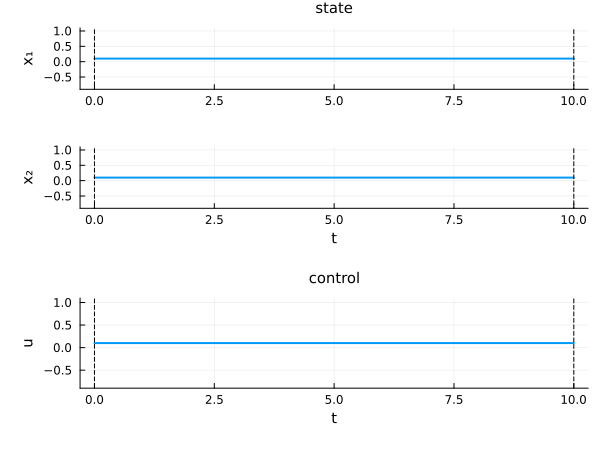
Solving with no guess at all, init=nothing, and init=() are all equivalent — all three skip straight to the default:
sol = solve(ocp1; display=false)
println("no init:         ", iterations(sol), " iterations")

sol = solve(ocp1; init=nothing, display=false)
println("init=nothing:     ", iterations(sol), " iterations")

sol = solve(ocp1; init=(), display=false)
println("init=():          ", iterations(sol), " iterations")
no init: 10 iterations
init=nothing: 10 iterations
init=(): 10 iterationsThe @init macro
@init builds an initial guess with the syntax label(t) := expression (functions of time) or label := value (for variables and aliases, which aren't functions of time):
ig = @init ocp begin
    # specifications
end| Component | Form | Example |
|---|---|---|
| State / control, function of time | label(t) := expression | u(t) := -0.2t |
| State / control, constant | label(t) := value or label := value | u := 2 |
| State / control, on a grid | label(T) := data, T a time vector | u(T) := U |
| Variable | label := value | tf := 2.0 |
| Alias (local name) | name = expression | a = 0.5 |
1-D components take a scalar (u(t) := 2), following the 1-D is a scalar rule; multi-D components take a vector (x(t) := [1, 2]).
The indexed syntax x[1](t) := ... is not supported — @init works at the level of declared labels, not array positions; use x₁(t) := ... or a component's own name instead.
Constant
ig = @init ocp1 begin
    x(t) := [-0.2, 0.1]
    u(t) := -0.2
end

sol = solve(ocp1; init=ig, display=false)
println(iterations(sol), " iterations")
9 iterationsConstants also accept the shorter form without the time argument (u := 2 instead of u(t) := 2):
ig = @init ocp2 begin
    q := -0.2
    v := 0.0
    u := 0.1
    tf := 2.0
end

sol = solve(ocp2; init=ig, display=false)
println(iterations(sol), " iterations")
15 iterationsPartial
Uninitialized components fall back to 0.1:
ig = @init ocp1 begin
    u(t) := -0.2
end

sol = solve(ocp1; init=ig, display=false)
println(iterations(sol), " iterations")
7 iterationsTime-dependent functions
ig = @init ocp1 begin
    x(t) := [-0.2t, 0.1t]
    u(t) := -0.2t
end

sol = solve(ocp1; init=ig, display=false)
println(iterations(sol), " iterations")
14 iterationsAliases
= (no time argument) defines a local alias, not a problem label:
ig = @init ocp2 begin
    amplitude = 0.5
    φ = 2π * s
    q(s) := amplitude * sin(φ)
    v(s) := amplitude * cos(φ)
    u(s) := sin(amplitude)
    tf := 2.0
end

sol = solve(ocp2; init=ig, display=false)
println(iterations(sol), " iterations")
12 iterationsCross-spec references
Specifications inside one @init block can reference each other, from top to bottom:
a reference only resolves to a label (or alias) defined earlier in the block;
substitution happens by name: the referenced label is replaced by its definition when the later expression is evaluated;
grid specs are not substituted (see the note below).
Temporal → temporal, and chains. v references q, and u references v, hence q:
ig = @init ocp2 begin
    q(s) := sin(s)
    v(s) := 1.0 + q(s)      # references q
    u(s) := s + v(s)^2      # transitively references q via v
    tf := 2.0
end

sol = solve(ocp2; init=ig, display=false)
println(iterations(sol), " iterations")
26 iterationsConstant → temporal. A function of time can use a constant defined earlier:
ig = @init ocp2 begin
    q    := -1.0
    v(s) := q + sin(s)      # uses the constant value of q
    u(s) := 0.0
    tf   := 2.0
end

sol = solve(ocp2; init=ig, display=false)
println(iterations(sol), " iterations")
39 iterationsConstant → constant. A constant can use another one, including between the components of a variable. Here the variable has two components, (tf, a), and the guess is read back with variable:
ocp_var2 = @def begin
    w = (tf, a) ∈ R², variable
    t ∈ [0, 1], time
    x ∈ R, state
    u ∈ R, control
    x(0) == 0
    x(1) - a == 0
    ẋ(t) == u(t)
    ∫(0.5u(t)^2) → min
end

ig = @init ocp_var2 begin
    tf := 1.0
    a  := tf + 0.5
end

variable(ig)
2-element Vector{Float64}:
1.0
1.5With aliases. Aliases (=) and references (:=) combine freely:
ig = @init ocp2 begin
    A    = 2.0              # alias
    q(s) := A * sin(s)      # uses the alias
    v(s) := q(s) + 1.0      # references q
    u(s) := 0.0
    tf   := 2.0
end

sol = solve(ocp2; init=ig, display=false)
println(iterations(sol), " iterations")
21 iterationsNo substitution across grid specs
A grid spec (label(T) := data, see below) lives in a different evaluation context: it is not substituted into a spec written with the time variable, or vice versa. Keep one style per chain of references.
Vector initial guess (interpolated)
label(T) := data, with T a time vector, interpolates data onto the solve grid:
T = [0.0, 5.0, 10.0]
X = [[-1.0, 0.0], [-0.5, 0.5], [0.0, 0.0]]
U = [0.0, -0.5, 0.0]

ig = @init ocp1 begin
    x(T) := X
    u(T) := U
end

sol = solve(ocp1; init=ig, display=false)
println(iterations(sol), " iterations")
14 iterationsDifferent components can use different grids:
Sq = [0.0, 1.0, 2.0]; Dq = [-1.0, -0.5, 0.0]
Sv = [0.0, 2.0];      Dv = [0.0, 0.0]
Su = [0.0, 1.0, 2.0]; Du = [0.0, 0.5, 0.0]

ig = @init ocp2 begin
    q(Sq) := Dq
    v(Sv) := Dv
    u(Su) := Du
    tf := 2.0
end

sol = solve(ocp2; init=ig, display=false)
println(iterations(sol), " iterations")
12 iterationsFor state, a matrix (one row per time point) works too:
T = [0.0, 5.0, 10.0]
Xmat = [-1.0 0.0; -0.5 0.5; 0.0 0.0]
U = [0.0, -0.5, 0.0]

ig = @init ocp1 begin
    x(T) := Xmat
    u(T) := U
end

sol = solve(ocp1; init=ig, display=false)
println(iterations(sol), " iterations")
14 iterationsMixing them
Constants, functions, and grids combine freely in one @init block:
T = [0.0, 5.0, 10.0]
X = [[-1.0, 0.0], [-0.5, 0.5], [0.0, 0.0]]

ig = @init ocp1 begin
    x(T) := X               # grid
    u(t) := -0.2 * sin(t)   # function
end

sol = solve(ocp1; init=ig, display=false)
println(iterations(sol), " iterations")
14 iterationsWarm start from a solution
Pass a Solution directly — dimensions of state, control, and variable must match. This is the basis for discrete continuation:
sol_init = solve(ocp1; display=false)
sol = solve(ocp1; init=sol_init, display=false)
println(iterations(sol), " iterations")
0 iterationsOr extract functions from a solution and feed them through @init:
x_fun = state(sol_init)
u_fun = control(sol_init)

ig = @init ocp1 begin
    x(t) := x_fun(t)
    u(t) := u_fun(t)
end

sol = solve(ocp1; init=ig, display=false)
println(iterations(sol), " iterations")
0 iterationsstate, costate and control on a solution return functions of time; variable returns the value of the variable (a scalar for a 1-D variable, a vector otherwise).
Without @init: a named tuple
init also accepts a named tuple with the fields state, control and variable, each a constant or a function of time (any subset of them):
sol = solve(ocp2; init=(state=s -> [-1 + s, 0.0], control=0.1, variable=2.0), display=false)
println(iterations(sol), " iterations")
13 iterationsInspect a guess
Whatever you pass as init, solve turns it into an initial guess with build_initial_guess(ocp, init). You can call it yourself, and read the result back with state, control and variable, as on a solution. Components that are not specified take the default value 0.1:
ig = build_initial_guess(ocp2, @init(ocp2, begin
    q(s) := sin(s)
    tf := 2.0
end))
state(ig)(0.5), control(ig)(0.5), variable(ig)
([0.479425538604203, 0.1], 0.1, 2.0)The same holds for the output of @init itself, which is an initial guess already.
Costate and multipliers
There is currently no way to seed the costate or the multipliers — only state, control, and variable accept an initial guess.
init or initial_guess
init is an alias for initial_guess; use whichever reads better, but not both in the same call. In descriptive mode, passing both is reported as an unknown option :init rather than as a conflict (OptimalControl#964).
See also
Solve overview — the rest of what
solveaccepts.Solution object —
state,costate,control,variableon a returned solution.Abstract syntax (
@def) — where the labels@inituses come from.