
Your first problem
The shortest complete story: define a problem, solve it, look at the result, and check it against the exact answer. No options, no theory: every line is explained, and the other pages go deeper.
The problem
A wagon moves along a rail. Its position is 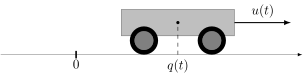
Starting at rest at
where
Define it
We load OptimalControl to write the problem and NLPModelsIpopt to solve it (see Installation), then transcribe the formulation with @def:
using OptimalControl
using NLPModelsIpopt

ocp = @def begin
    t ∈ [0, 1], time
    x = (q, v) ∈ R², state
    u ∈ R, control
    x(0) == [-1, 0]
    x(1) == [0, 0]
    ẋ(t) == [v(t), u(t)]
    0.5∫(u(t)^2) → min
end
Each line mirrors the mathematics:
| Line | Meaning |
|---|---|
t ∈ [0, 1], time | the time variable and its fixed interval |
x = (q, v) ∈ R², state | a two-dimensional state, whose components are named q and v |
u ∈ R, control | a scalar control |
x(0) == [-1, 0], x(1) == [0, 0] | the initial and final conditions |
ẋ(t) == [v(t), u(t)] | the dynamics |
0.5∫(u(t)^2) → min | the cost to minimise |
See Abstract syntax (@def) for every form these lines can take.
Solve it
solve discretises the problem in time and hands the resulting finite-dimensional problem to Ipopt:
sol = solve(ocp)▫ This is OptimalControl 2.2.1-beta, solving with: collocation → adnlp → ipopt (cpu)
📦 Configuration:
├─ Discretizer: collocation
├─ Modeler: adnlp
└─ Solver: ipopt
▫ This is Ipopt version 3.14.19, running with linear solver MUMPS 5.9.0.
Number of nonzeros in equality constraint Jacobian...: 1754
Number of nonzeros in inequality constraint Jacobian.: 0
Number of nonzeros in Lagrangian Hessian.............: 250
Total number of variables............................: 752
variables with only lower bounds: 0
variables with lower and upper bounds: 0
variables with only upper bounds: 0
Total number of equality constraints.................: 504
Total number of inequality constraints...............: 0
inequality constraints with only lower bounds: 0
inequality constraints with lower and upper bounds: 0
inequality constraints with only upper bounds: 0
iter objective inf_pr inf_du lg(mu) ||d|| lg(rg) alpha_du alpha_pr ls
0 5.0000000e-03 1.10e+00 2.24e-14 0.0 0.00e+00 - 0.00e+00 0.00e+00 0
1 6.0000960e+00 2.22e-16 1.78e-15 -11.0 6.08e+00 - 1.00e+00 1.00e+00h 1
Number of Iterations....: 1
(scaled) (unscaled)
Objective...............: 6.0000960015360381e+00 6.0000960015360381e+00
Dual infeasibility......: 1.7763568394002505e-15 1.7763568394002505e-15
Constraint violation....: 2.2204460492503131e-16 2.2204460492503131e-16
Variable bound violation: 0.0000000000000000e+00 0.0000000000000000e+00
Complementarity.........: 0.0000000000000000e+00 0.0000000000000000e+00
Overall NLP error.......: 1.7763568394002505e-15 1.7763568394002505e-15
Number of objective function evaluations = 2
Number of objective gradient evaluations = 2
Number of equality constraint evaluations = 2
Number of inequality constraint evaluations = 0
Number of equality constraint Jacobian evaluations = 2
Number of inequality constraint Jacobian evaluations = 0
Number of Lagrangian Hessian evaluations = 1
Total seconds in IPOPT = 4.598
EXIT: Optimal Solution Found.The first box names the method that ran: solve(ocp) was called without any method, so it used the default (:collocation, :adnlp, :ipopt, :cpu). The rest is Ipopt's log. EXIT: Optimal Solution Found is the line to look for. Ipopt needs a single iteration here because the dynamics are linear and the cost is quadratic.
Look at it
Plots draws the solution:
using Plots
plot(sol)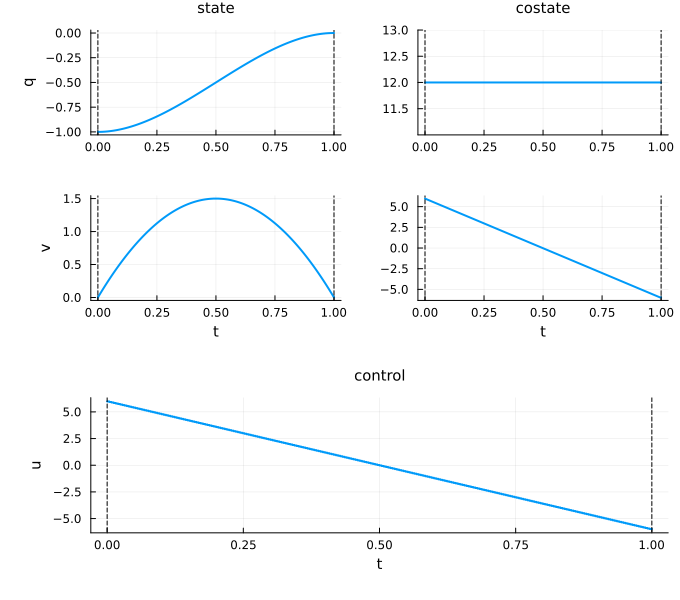
The figure shows the state
The solution also carries the cost and a few solver diagnostics:
objective(sol), iterations(sol), successful(sol)(6.000096001536038, 1, true)The state and the control are functions of time. Because the control is scalar, control(sol) returns a Number, not a length-1 vector (see the note on dimension one):
state(sol)(0.5), control(sol)(0.25)([-0.5000000000000006, 1.5000240003840084], 3.0000480007680177)See Solution object for everything else a solution carries, and Plot for what else plot can show.
Check it
This problem can be solved by hand: the optimal control is
objective(sol) - 69.60015360380595e-5The energy minimisation example derives this exact solution with the maximum principle and recovers it by indirect shooting.
Next
Choosing a method — pick a different solver, modeler, or grid.
Guided tour — the same problem in more depth, plus the indirect (Pontryagin) method and a second, harder problem.
Example gallery — worked problems covering singular arcs, state constraints, free variables, and more.