
Constrained arcs
Along a boundary arc, a state constraint is active, and the flow needs more than a control law: the constraint and its multiplier. This page builds such flows, and assembles them with the unconstrained arcs, on two problems with known solutions.
using OptimalControl
using OrdinaryDiffEqTsit5
using NLPModelsIpopt
using Plots
The setting
With the conventions of Notation and conventions, a state constraint is written
On the arc, differentiating Flow(ocp, law; constraint=c, multiplier=μ) integrates the corresponding Hamiltonian flow. The functions have the signatures
c([t, ]x, u[, v])    # the constraint, c ≥ 0
u([t, ]x, p[, v])    # the control law on the arc
μ([t, ]x, p[, v])    # the multiplier on the arc
with t for a non-autonomous problem and v for a problem with a variable.
A constraint of order one
This example comes from the v2.0.4 manual, after Bonnard, Faubourg, Launay and Trélat[1]. Minimise
t0, tf = 0, 2
x0, xf = 1, 1 / 2
lb = 0.1

ocp = @def begin
    t ∈ [t0, tf], time
    x ∈ R, state
    u ∈ R, control
    -1 ≤ u(t) ≤ 1
    x(t0) == x0
    x(tf) == xf
    x(t) - lb ≥ 0, (x_con)
    ẋ(t) == u(t)
    ∫(x(t)^2) → min
end
Here
c(x, u) = x - lb         # the constraint, c ≥ 0
u_b(x, p) = 0            # the control on the boundary arc
μ(x, p) = 2x             # the multiplier on the boundary arc

f_minus = Flow(ocp, (x, p) -> -1)
f_boundary = Flow(ocp, u_b; constraint=c, multiplier=μ)
f_plus = Flow(ocp, (x, p) -> 1)

t1, t2 = 0.9, 1.6
f = f_minus * (t1, f_boundary) * (t2, f_plus)

p0 = -0.982237546583301
zf = f(t0, x0, p0, tf)
2-element Vector{Float64}:
0.5000000000000001
0.2477624534167015The concatenation reaches [x; p], see Multi-phase flows). The direct method finds the same boundary arc,
sol_d = solve(ocp; grid_size=400, display=false)
sol_f = f((t0, tf), x0, p0)
objective(sol_d), objective(sol_f)
(0.3813306239985142, 0.381333893408902)constraint and multiplier go together: one without the other is rejected.
julia> Flow(ocp, u_b; constraint=c)
IncorrectArgument → top-level scope, REPL[1]:2
│
│  `constraint` and `multiplier` must be given together
│
│  Got       only `constraint`
│  Expected  both `constraint` and `multiplier`, or neither
│
│  Context   Flow(ocp, law; constraint=…, multiplier=…) — pairing check
└─
Other ways to give the constraint
The constraint can also be a typed StateConstraint (or ControlConstraint, MixedConstraint, PathConstraint for constraints that involve the control), with the same result:
f_typed = Flow(ocp, u_b; constraint=StateConstraint(x -> x - lb), multiplier=μ)
f_typed(t1, lb, 0.0, t2), f_boundary(t1, lb, 0.0, t2)
((0.1, 0.0), (0.1, 0.0))Several constraints active on the same arc are given as tuples, one multiplier per constraint:
f_two = Flow(ocp, u_b;
    constraint=(c, (x, u) -> 10 - x),     # a second constraint, x ≤ 10, inactive
    multiplier=(μ, (x, p) -> 0))
f_two(t1, lb, 0.0, t2)
(0.1, 0.0)Finally, constraint=:x_con names a path constraint of the problem by its label. It uses the function stored in the model as it is, without its bound: the result is right only when the constraint is written as here, c(x) ≥ 0. Written x(t) ≥ lb or lb - x(t) ≤ 0, the flow on the arc is wrong, without an error (CTFlows#440). The examples of this documentation use the function form.
A costate jump: a constraint of order two
This example also comes from the v2.0.4 manual. It is the Bryson–Denham problem: minimise
l = 1 / 9

ocp_bd = @def begin
    t ∈ [0, 1], time
    x ∈ R², state
    u ∈ R, control
    x(0) == [0, 1]
    x(1) == [0, -1]
    x₁(t) ≤ l, (x_con)
    ẋ(t) == [x₂(t), u(t)]
    0.5∫(u(t)^2) → min
end
Here
f_free = Flow(ocp_bd, (x, p) -> p[2])
f_arc = Flow(ocp_bd, (x, p) -> 0; constraint=(x, u) -> l - x[1], multiplier=(x, p) -> 0)

ν = 18
f_bd = f_free * (3l, [ν, 0], f_arc) * (1 - 3l, [ν, 0], f_free)
zf_bd = f_bd(0, [0, 1], [-18, -6], 1)
4-element Vector{Float64}:
-4.378891374111009e-16
-0.9999999999999994
18.0
-5.999999999999999The flow reaches the target
sol_bd = solve(ocp_bd; display=false)
sol_bd_flow = f_bd((0, 1), [0, 1], [-18, -6])
objective(sol_bd), objective(sol_bd_flow)
(4.000142991483484, 4.000000525894766)To plot the flow against the direct solution, the same flows are built with saveat, so that the trajectory has enough points (see Plotting a flow). Use such flows for trajectories only: their point call returns the value at the last saveat time, not at the final time (CTFlows#441).
fine = (saveat=range(0, 1, 101), dense=false)
f_bd_fine = Flow(ocp_bd, (x, p) -> p[2]; fine...) *
    (3l, [ν, 0], Flow(ocp_bd, (x, p) -> 0; constraint=(x, u) -> l - x[1], multiplier=(x, p) -> 0, fine...)) *
    (1 - 3l, [ν, 0], Flow(ocp_bd, (x, p) -> p[2]; fine...))
sol_bd_fine = f_bd_fine((0, 1), [0, 1], [-18, -6])plt = plot(sol_bd; label="direct", size=(800, 600))
plot!(plt, sol_bd_fine; label="flow", linestyle=:dash)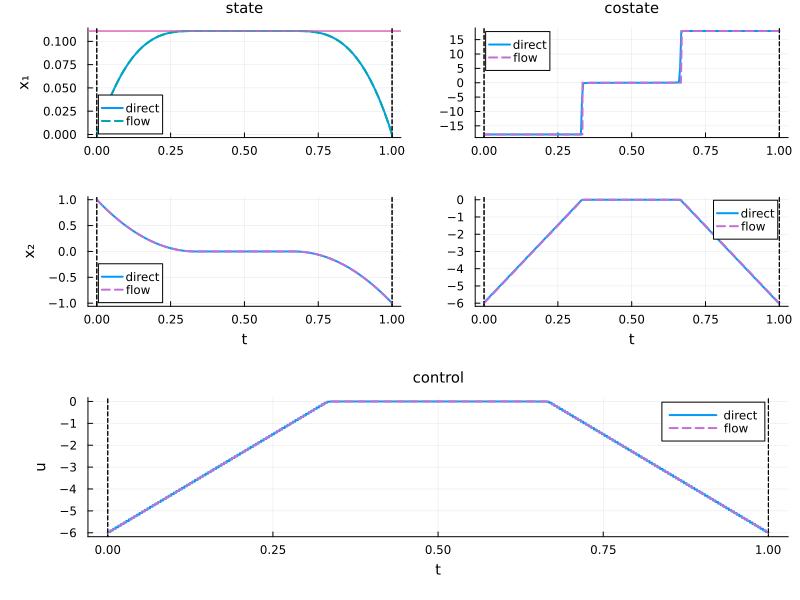
Partial Hamiltonian
hamiltonian_type=:partial (see Total or partial Hamiltonian) applies to a constrained arc too. Along an optimal boundary arc, the law and the multiplier make both forms give the same flow:
f_partial = Flow(ocp, u_b; constraint=c, multiplier=μ, hamiltonian_type=:partial)
f_partial(t1, lb, 0.0, t2)
(0.1, 0.0)Control-free problems
A problem without a control has no boundary arcs in this sense: its flow rejects constraint and multiplier.
julia> ocp_cf = @def begin
           t ∈ [0, 1], time
           x ∈ R, state
           x(0) == 1
           ẋ(t) == -x(t)
           ∫(x(t)^2) → min
       end;

julia> Flow(ocp_cf; constraint=(x, u) -> 1, multiplier=(x, p) -> 1)
PreconditionError → top-level scope, REPL[2]:2
│
│  constrained flows are not supported for control-free problems
│
│  Reason   a `constraint`/`multiplier` pair augments the pseudo-Hamiltonian H̃ + μ·g with the control; a control-free Flow(ocp) has no control law and no pseudo-Hamiltonian to carry the constraint term
│
│  Context  Flow(ocp; constraint=…, multiplier=…) — control-free constraint guard
│  Hint     use Flow(ocp, law; constraint=…, multiplier=…) with a control law
└─
See also
Multi-phase flows: concatenations and jumps.
Shooting: solve for the junction times and the initial costate.
State constraint: a speed constraint on the double integrator, from the direct solution to the shooting.
B. Bonnard, L. Faubourg, G. Launay and E. Trélat, Optimal control with state constraints and the space shuttle re-entry problem, J. Dyn. Control Syst. 9 (2003), no. 2, 155–199. ↩︎