A simple Linear–quadratic regulator example
Problem statement
We consider the following Linear Quadratic Regulator (LQR) problem, which consists in minimizing
\[ \frac{1}{2} \int_{0}^{t_f} \left( x_1^2(t) + x_2^2(t) + u^2(t) \right) \, \mathrm{d}t \]
subject to the dynamics
\[ \dot x_1(t) = x_2(t), \quad \dot x_2(t) = -x_1(t) + u(t), \quad u(t) \in \mathbb{R}\]
and the initial condition
\[ x(0) = (0,1).\]
We aim to solve this optimal control problem for different values of $t_f$.
Required packages
We begin by importing the necessary packages:
using OptimalControl
using NLPModelsIpopt
using Plots
using Plots.PlotMeasures # for leftmargin, bottommargin
Problem definition
We define the LQR problem as a function of the final time tf:
function lqr(tf)

    x0 = [ 0
           1 ]

    ocp = @def begin
        t ∈ [0, tf], time
        x ∈ R², state
        u ∈ R, control
        x(0) == x0
        ẋ(t) == [x₂(t), - x₁(t) + u(t)]
        0.5∫( x₁(t)^2 + x₂(t)^2 + u(t)^2 ) → min
    end

    return ocp
endClick to unfold and see the matrix form.
The problem can also be written using matrix notation with the backend=:default option:
x0 = [ 0
       1 ]
A  = [ 0 1
      -1 0 ]
B  = [ 0
       1 ]
Q  = [ 1 0
       0 1 ]
R  = 1
tf = 3

ocp = @def begin
    t ∈ [0, tf], time
    x ∈ R², state
    u ∈ R, control
    x(0) == x0
    ẋ(t) == A * x(t) + B * u(t)
    0.5∫( x(t)' * Q * x(t) + u(t)' * R * u(t) ) → min
end

solve(ocp; backend=:default, display=false)
• Solver:
✓ Successful : true
│ Status : first_order
│ Message : Ipopt/generic
│ Iterations : 1
│ Objective : 0.6487769511462064
└─ Constraints violation : 1.6653345369377348e-16
• Boundary duals: [-0.3840292738668005, -1.2975539022924134]
Not using backend=:default with the ADNLPModels modeler (the default one) for the matrix form will lead to an error. This is a known issue.
Solving the problem for different final times
We solve the problem for $t_f \in \{3, 5, 30\}$.
solutions = []   # empty list of solutions
tfs = [3, 5, 30]

for tf ∈ tfs
    solution = solve(lqr(tf), display=false)
    push!(solutions, solution)
end

# Display costs and final states
for i ∈ eachindex(solutions)
    x_func = state(solutions[i])
    obj = objective(solutions[i])
    println("tf = $(tfs[i]): cost = ", obj, ", x(tf) = ", x_func(tfs[i]))
end
tf = 3: cost = 0.6487769511462066, x(tf) = [-0.007109901575137315, -0.29045114508110004]
tf = 5: cost = 0.6739978893835569, x(tf) = [-0.05967937514820354, 0.03998436697726532]
tf = 30: cost = 0.6760967247269782, x(tf) = [-3.082783736618744e-9, -4.5086420707995956e-10]Plotting the Solutions
We plot the state and control variables using normalized time $s = (t - t_0)/(t_f - t_0)$:
plt = plot()
for i ∈ eachindex(solutions)
    plot!(plt, solutions[i], :state, :control; time=:normalize, label="tf = $(tfs[i])")
end

px1 = plot(plt[1], legend=false, xlabel="s", ylabel="x₁")
px2 = plot(plt[2], legend=true, xlabel="s", ylabel="x₂")
pu  = plot(plt[3], legend=false, xlabel="s", ylabel="u")
plot(px1, px2, pu, layout=(1, 3), size=(800, 300), leftmargin=5mm, bottommargin=5mm)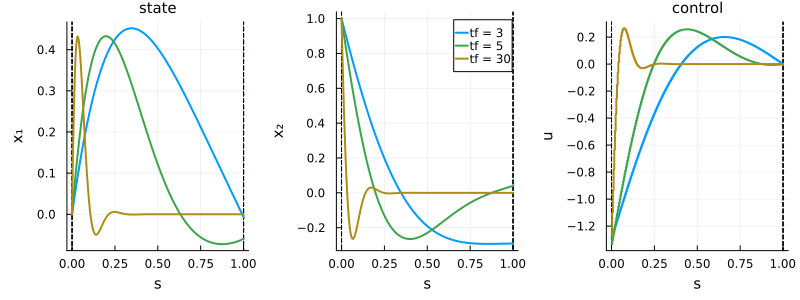
We can observe that $x(t_f)$ converges to the origin as $t_f$ increases. This illustrates a fundamental property of the LQR problem: as the horizon extends, the optimal solution approaches the steady-state infinite-horizon LQR regulator, which drives the state to the origin with minimal cost.