Optimal control problem with free final time
This tutorial is part of a series on optimal control problems with free time variables. See also: Free initial time and Free initial and final times.
In this tutorial, we study an optimal control problem with a free final time tf. The following packages are required:
using LinearAlgebra: norm     # For vector norm
using NLPModelsIpopt          # Direct solver
using NonlinearSolve          # Indirect solver
using OptimalControl          # Main package
using OrdinaryDiffEq          # ODE integration
using Plots                   # Visualization
using Printf                  # Formatted output
Definition of the problem
We consider the following setup:
t0 = 0       # Initial time
x0 = [0, 0]  # Initial state
xf = [1, 0]  # Desired final state

@def ocp begin

    tf ∈ R, variable           # Final time is free (a decision variable)
    t ∈ [t0, tf], time         # Time interval depends on tf
    x ∈ R², state              # State vector x = [x₁, x₂]
    u ∈ R, control             # Scalar control

    # Control and time constraints
    -1 ≤ u(t) ≤ 1
    0.05 ≤ tf ≤ Inf            # Lower bound helps numerical convergence

    # Boundary conditions
    x(t0) == x0
    x(tf) == xf

    # Dynamics
    ẋ(t) == [x₂(t), u(t)]

    # Objective: minimize final time
    tf → min
end
The free final time nature of the problem is explicitly stated by:
tf ∈ R, variableand the time definition
t ∈ [t0, tf], timeindicates that the time horizon itself depends on the optimization variable tf.
Direct resolution
To improve convergence of the direct solver, we constrain tf as follows:
0.05 ≤ tf ≤ InfWe then solve the optimal control problem with a direct method, using an automatic handling of the free final time:
sol = solve(ocp; grid_size=100)▫ This is OptimalControl 2.0.4, solving with: collocation → adnlp → ipopt (cpu)
📦 Configuration:
├─ Discretizer: collocation (grid_size = 100)
├─ Modeler: adnlp
└─ Solver: ipopt
▫ This is Ipopt version 3.14.19, running with linear solver MUMPS 5.8.2.
Number of nonzeros in equality constraint Jacobian...: 904
Number of nonzeros in inequality constraint Jacobian.: 0
Number of nonzeros in Lagrangian Hessian.............: 201
Total number of variables............................: 303
variables with only lower bounds: 1
variables with lower and upper bounds: 100
variables with only upper bounds: 0
Total number of equality constraints.................: 204
Total number of inequality constraints...............: 0
inequality constraints with only lower bounds: 0
inequality constraints with lower and upper bounds: 0
inequality constraints with only upper bounds: 0
iter objective inf_pr inf_du lg(mu) ||d|| lg(rg) alpha_du alpha_pr ls
0 1.0000000e-01 9.00e-01 0.00e+00 0.0 0.00e+00 - 0.00e+00 0.00e+00 0
1 3.5801080e-01 8.77e-01 1.22e+02 1.0 1.05e+01 - 3.05e-01 2.58e-02f 3
2 8.8421252e-01 8.25e-01 5.41e+02 0.4 9.70e+00 - 8.29e-02 5.87e-02h 2
3 1.4678934e+00 6.93e-01 1.76e+02 0.6 3.64e+00 - 1.00e+00 1.60e-01h 1
4 3.2773408e+00 7.30e-03 1.40e+02 0.5 1.81e+00 - 9.77e-01 1.00e+00f 1
5 2.8033485e+00 5.21e-04 1.71e+01 -1.0 4.74e-01 - 9.79e-01 1.00e+00h 1
6 2.6891402e+00 4.60e-05 9.92e-02 -2.2 1.14e-01 0.0 1.00e+00 1.00e+00h 1
7 2.2992781e+00 1.01e-03 1.33e-01 -2.9 3.90e-01 - 1.00e+00 1.00e+00f 1
8 2.0121466e+00 1.61e-03 2.23e-02 -3.3 5.60e-01 - 9.90e-01 1.00e+00h 1
9 2.0190855e+00 1.44e-04 2.22e-03 -3.7 6.95e-01 - 9.85e-01 9.08e-01h 1
iter objective inf_pr inf_du lg(mu) ||d|| lg(rg) alpha_du alpha_pr ls
10 2.0056026e+00 8.34e-05 6.84e-04 -5.3 8.80e-01 - 7.56e-01 7.58e-01h 1
11 2.0005424e+00 4.50e-05 1.99e-05 -5.3 8.89e-01 - 9.86e-01 1.00e+00h 1
12 2.0000009e+00 2.13e-07 3.71e-07 -11.0 3.65e-02 - 9.82e-01 1.00e+00h 1
13 2.0000000e+00 4.91e-12 5.81e-13 -11.0 5.49e-04 - 1.00e+00 1.00e+00h 1
Number of Iterations....: 13
(scaled) (unscaled)
Objective...............: 1.9999999910286173e+00 1.9999999910286173e+00
Dual infeasibility......: 5.8070724833041256e-13 5.8070724833041256e-13
Constraint violation....: 4.9146242631081805e-12 4.9146242631081805e-12
Variable bound violation: 9.4892587121364613e-09 9.4892587121364613e-09
Complementarity.........: 1.6476668104039873e-11 1.6476668104039873e-11
Overall NLP error.......: 1.6476668104039873e-11 1.6476668104039873e-11
Number of objective function evaluations = 19
Number of objective gradient evaluations = 14
Number of equality constraint evaluations = 19
Number of inequality constraint evaluations = 0
Number of equality constraint Jacobian evaluations = 14
Number of inequality constraint Jacobian evaluations = 0
Number of Lagrangian Hessian evaluations = 13
Total seconds in IPOPT = 3.706
EXIT: Optimal Solution Found.The solution can be visualized as:
plt = plot(sol; label="direct", size=(800, 600))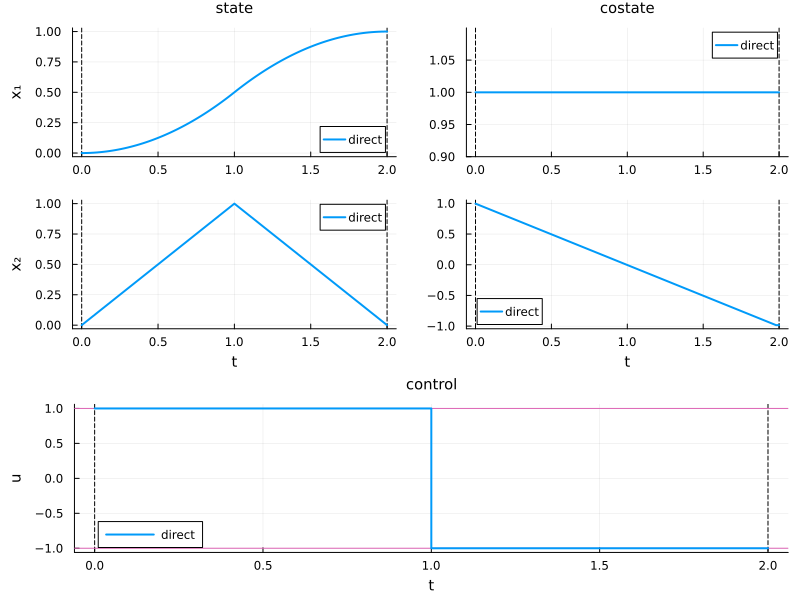
Verification of the results
Using Pontryagin's Maximum Principle, we know that the optimal trajectory consists of two arcs: one with $u=1$ and one with $u=-1$. Without further calculations, the optimal trajectory is:
\[x_1(t) = \begin{cases} \tfrac{1}{2}t^2, & t \in [0,1),\\ -\tfrac{1}{2}t^2 + 2t - 1, & t \in [1,2], \end{cases} \quad x_2(t) = \begin{cases} t, & t \in [0,1),\\ 2-t, & t \in [1,2]. \end{cases}\]
The optimal control is:
\[u(t) = \begin{cases} 1, & t \in [0,1),\\ -1, & t \in [1,2]. \end{cases}\]
And the costate, the switching time and the final time are:
\[p_1(t)=1, \quad p_2(t)=1-t, \quad p^0=-1, \quad t_1 = 1, \quad t_f = 2.\]
We can now compare the direct numerical solution with this theoretical result:
tf = variable(sol)
u = control(sol)
p = costate(sol)
x = state(sol)
H(t) = p(t)[1]*x(t)[2] + p(t)[2]*u(t)

@printf("tf = %.5f", tf); println(lpad("(expected 2)", 33))
@printf("H(t0) = %.5f", H(t0)); println(lpad("(expected 1)", 30))
@printf("H(tf) = %.5f", H(tf)); println(lpad("(expected 1)", 30))
@printf("x(t0) = [%.5f, %.5f]", x(t0)[1], x(t0)[2]); println(lpad("(expected [0, 0])", 23))
@printf("x(tf) = [%.5f, %.5f]", x(tf)[1], x(tf)[2]); println(lpad("(expected [1, 0])", 23))
@printf("p(t0) = [%.5f, %.5f]", p(t0)[1], p(t0)[2]); println(lpad("(expected [1, 1])", 24))
@printf("p(tf) = [%.5f, %.5f]", p(tf)[1], p(tf)[2]); println(lpad("(expected [1, -1])", 24))
tf = 2.00000 (expected 2)
H(t0) = 0.99568 (expected 1)
H(tf) = 0.98432 (expected 1)
x(t0) = [0.00000, -0.00000] (expected [0, 0])
x(tf) = [1.00000, -0.00000] (expected [1, 0])
p(t0) = [1.00000, 0.99568] (expected [1, 1])
p(tf) = [1.00000, -0.98432] (expected [1, -1])The numerical results match the theoretical solution almost exactly.
Indirect method
We now solve the same problem using an indirect method (shooting approach). We begin by defining the pseudo-Hamiltonian and the switching function.
# Pseudo-Hamiltonian
H(x, p, u) = p[1]*x[2] + p[2]*u

# Hamiltonian lift used to compute the switching function
F1(x) = [0, 1]
H1 = Lift(F1)
Define the flows corresponding to the two control laws $u=+1$ and $u=-1$:
const u_pos = 1
const u_neg = -1

# Each flow depends on tf since it is part of the optimization variables
f_pos = Flow(ocp, (x, p, tf) -> u_pos)
f_neg = Flow(ocp, (x, p, tf) -> u_neg)
The shooting function enforces the final and switching conditions:
function shoot!(s, p0, t1, tf)
    x_t0 = x0
    p_t0 = p0

    # Forward integration under u = +1, then u = -1
    x_t1, p_t1 = f_pos(t0, x_t0, p_t0, t1)
    x_tf, p_tf = f_neg(t1, x_t1, p_t1, tf)

    u_tf = -1  # Final control

    # Shooting conditions:
    s[1:2] = x_tf - xf                # Terminal state must match xf
    s[3]   = H(x_tf, p_tf, u_tf) - 1  # Transversality condition
    s[4]   = H1(x_t1, p_t1)           # Switching condition φ(t₁)=0
end
To help the nonlinear solver converge, we build a good initial guess from the direct solution:
t = time_grid(sol)
x = state(sol)
p = costate(sol)
φ(t) = H1(x(t), p(t))  # Switching function

p0 = p(t0)
t1 = t[argmin(abs.(φ.(t)))]
tf = t[end]

println("p0 = ", p0)
println("t1 = ", t1)
println("tf = ", tf)

# Evaluate the norm of the shooting function at initial guess
s = zeros(4)
shoot!(s, p0, t1, tf)
println("\n‖s‖ (initial guess) = ", norm(s), "\n")
p0 = [0.9999999955091625, 0.9956848379593418]
t1 = 0.9999999955143086
tf = 1.9999999910286173
‖s‖ (initial guess) = 0.006102541639652266We can now solve the system using an indirect shooting method:
# Aggregated nonlinear system
shoot!(s, ξ, _) = shoot!(s, ξ[1:2], ξ[3], ξ[4])

# Define the problem and initial guess
ξ_guess = [p0..., t1, tf]
prob = NonlinearProblem(shoot!, ξ_guess)

# Solve the nonlinear system
indirect_sol = solve(prob; show_trace=Val(true), abstol=1e-8, reltol=1e-8)
Algorithm: NewtonRaphson(
    descent = NewtonDescent(),
    autodiff = AutoForwardDiff(),
    vjp_autodiff = AutoReverseDiff(
        compile = false
    ),
    jvp_autodiff = AutoForwardDiff(),
    concrete_jac = Val{false}()
)

----    	-------------       	-----------
Iter    	f(u) inf-norm       	Step 2-norm
----    	-------------       	-----------
0       	4.31515306e-03      	1.95781444e-153
1       	7.34009524e-16      	4.31516204e-03
Final   	7.34009524e-16
----------------------
retcode: Success
u: 4-element Vector{Float64}:
1.0
1.0000000000000002
1.0000000000000004
2.0000000000000004Finally, we compare the indirect solution to the direct one:
p0 = indirect_sol.u[1:2]
t1 = indirect_sol.u[3]
tf = indirect_sol.u[4]

# Reconstruct the full trajectory
f = f_pos * (t1, f_neg)
flow_sol = f((t0, tf), x0, p0; saveat=range(t0, tf, 200))

# Plot comparison
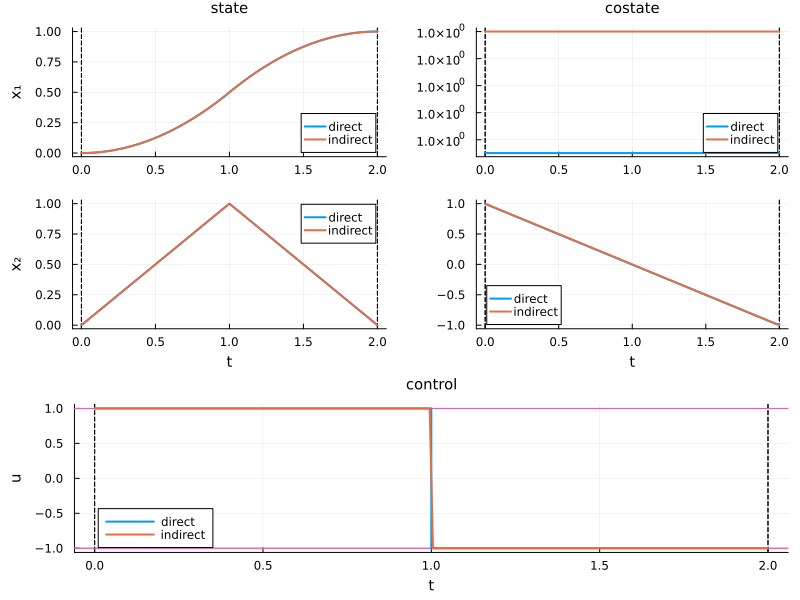
plot!(plt, flow_sol; label="indirect", color=2)